what kind of man gives cigarettes to trees
| Tobacco | |
|---|---|
 Tobacco flakes, sliced from pressed plugs | |
| Source found(s) | Nicotiana |
| Part(southward) of establish | Leaf |
| Geographic origin | The Americas |
| Active ingredients | Nicotine, harmine |
| Uses | Recreational |
| Legal condition |
|

Tobacco drying kiln in Myrtleford, Victoria, Commonwealth of australia, 2018. This kiln was built in 1957, and moved to Rotary Park in 2000. Kilns of this structure were made from the early 1930s through to the late 1960s.
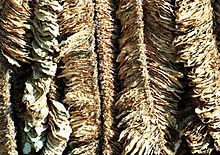
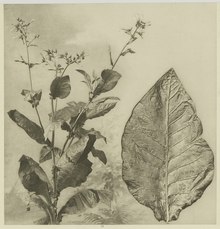
Tobacco is the common name of several plants in the genus Nicotiana of the family Solanaceae, and the full general term for any production prepared from the cured leaves of these plants. More than 70 species of tobacco are known, only the chief commercial crop is N. tabacum. The more potent variant North. rustica is also used in some countries.
Stale tobacco leaves are mainly used for smoking in cigarettes and cigars, every bit well every bit pipes and shishas. They can also be consumed as snuff, chewing tobacco, dipping tobacco and snus.
Tobacco contains the highly addictive stimulant alkaloid nicotine as well as harmala alkaloids.[3] Tobacco use is a cause or risk factor for many deadly diseases, especially those affecting the center, liver, and lungs, as well as many cancers. In 2008, the World Health Organisation named tobacco utilize as the world's single greatest preventable cause of death.[iv]
Etymology [edit]
The English word tobacco originates from the Spanish discussion "tabaco".[five] The precise origin of this word is disputed, merely it is generally thought to take derived, at to the lowest degree in part, from Taíno, the Arawakan language of the Caribbean. In Taíno, it was said to mean either a whorl of tobacco leaves (co-ordinate to Bartolomé de las Casas, 1552), or to tabago, a kind of L-shaped pipe used for sniffing tobacco fume (according to Oviedo, with the leaves themselves beingness referred to every bit cohiba).[6] [5]
Notwithstanding, mayhap coincidentally, similar words in Castilian, Portuguese and Italian were used from 1410 for certain medicinal herbs. These probably derived from the Arabic طُبّاق ṭubbāq (also طُباق ṭubāq ), a discussion reportedly dating to the 9th century, referring to various herbs.[7] [8]
History [edit]

Traditional utilise [edit]

The earliest delineation of a European human being smoking, from Tobacco by Anthony Chute, 1595.
Tobacco has long been used in the Americas, with some cultivation sites in Mexico dating back to 1400–grand BC.[9] Many Native American tribes traditionally grow and apply tobacco. Historically, people from the Northeast Woodlands cultures have carried tobacco in pouches as a readily accepted trade item. It was smoked both socially and ceremonially, such as to seal a peace treaty or trade agreement.[10] [11] In some Native cultures, tobacco is seen as a gift from the Creator, with the formalism tobacco smoke carrying one's thoughts and prayers to the Creator.[12]
Popularization [edit]

Following the inflow of the Europeans to the Americas, tobacco became increasingly popular as a trade item. Hernández de Boncalo, Spanish chronicler of the Indies, was the starting time European to bring tobacco seeds to the Old World in 1559 following orders of King Philip Two of Spain. These seeds were planted in the outskirts of Toledo, more specifically in an area known equally "Los Cigarrales" named after the continuous plagues of cicadas (cigarras in Castilian). Earlier the development of the lighter Virginia and white burley strains of tobacco, the smoke was too harsh to be inhaled. Small-scale quantities were smoked at a time, using a piping similar the midwakh or kiseru, or newly invented waterpipes such every bit the bong or the hookah (run into thuốc lào for a modern continuance of this practice). Tobacco became and so popular that the English colony of Jamestown used information technology as currency and began exporting it equally a cash crop; tobacco is often credited as being the export that saved Virginia from ruin.[13]
The alleged benefits of tobacco also contributed to its success. The astronomer Thomas Harriot, who accompanied Sir Richard Grenville on his 1585 expedition to Roanoke Island, idea that the establish "openeth all the pores and passages of the trunk" and so that the bodies of the natives "are notably preserved in wellness, and know non many grievous diseases, wherewithal we in England are often times affected."[14]
Product of tobacco for smoking, chewing, and snuffing became a major industry in Europe and its colonies by 1700.[15] [xvi]
Tobacco has been a major cash crop in Republic of cuba and in other parts of the Caribbean since the 18th century. Cuban cigars are globe-famous.[17]
In the late 19th century, cigarettes became pop. James Bonsack invented a auto to automate cigarette production. This increment in production allowed tremendous growth in the tobacco industry until the health revelations of the belatedly 20th century.[eighteen] [nineteen]
Contemporary [edit]
Following the scientific revelations of the mid-20th century, tobacco was condemned as a health hazard, and eventually became recognized equally a crusade of cancer, besides equally other respiratory and circulatory diseases. In the United states, this led to the Tobacco Master Settlement Agreement, which settled the many lawsuits by the U.S. states in exchange for a combination of yearly payments to the states and voluntary restrictions on advertisement and marketing of tobacco products.[ citation needed ]
In the 1970s, Brown & Williamson cross-bred a strain of tobacco to produce Y1, a strain containing an unusually high nicotine content, about doubling from 3.ii to iii.five%, to 6.v%. In the 1990s, this prompted the Food and Drug Administration to allege that tobacco companies were intentionally manipulating the nicotine content of cigarettes.[ citation needed ]
The desire of many addicted smokers to quit has led to the development of tobacco cessation products.[xx]
In 2003, in response to growth of tobacco use in developing countries, the World Health Organisation[21] successfully rallied 168 countries to sign the Framework Convention on Tobacco Control. The convention is designed to button for effective legislation and enforcement in all countries to reduce the harmful effects of tobacco.[22]
Between 2019 and 2021, concerns well-nigh increased COVID-19 health risks due to tobacco consumption facilitated smoking reduction and cessation.[23]
Biology [edit]
Nicotiana [edit]

Nicotine is the compound responsible for the addictive nature of tobacco employ.

Many species of tobacco are in the genus of herbs Nicotiana. It is role of the nightshade family (Solanaceae) ethnic to North and S America, Australia, south west Africa, and the Southward Pacific.[24]
Most nightshades contain varying amounts of nicotine, a powerful neurotoxin to insects. Even so, tobaccos tend to comprise a much higher concentration of nicotine than the others. Different many other Solanaceae species, they do not contain tropane alkaloids, which are often poisonous to humans and other animals.
Despite containing enough nicotine and other compounds such every bit germacrene and anabasine and other piperidine alkaloids (varying between species) to deter most herbivores,[25] a number of such animals have evolved the ability to feed on Nicotiana species without existence harmed. Still, tobacco is unpalatable to many species due to its other attributes. For case, although the cabbage looper is a generalist pest, tobacco'south gummosis and trichomes tin impairment early larvae survival.[26] As a upshot, some tobacco plants (chiefly Northward. glauca) have become established as invasive weeds in some places.
Types [edit]
The types of tobacco include:
- Aromatic burn down-cured is cured by fume from open fires. In the United States, information technology is grown in northern middle Tennessee, central Kentucky, and Virginia. Fire-cured tobacco grown in Kentucky and Tennessee is used in some chewing tobaccos, moist snuff, some cigarettes, and as a condiment in piping tobacco blends. Some other fire-cured tobacco is Latakia, which is produced from oriental varieties of N. tabacum. The leaves are cured and smoked over smoldering fires of local hardwoods and effluvious shrubs in Cyprus and Syria.
- Brightleaf tobacco is commonly known as "Virginia tobacco", frequently regardless of the state where it is planted. Prior to the American Civil War, most tobacco grown in the U.s. was fire-cured dark-foliage. Sometime afterward the War of 1812, need for a milder, lighter, more effluvious tobacco arose. Ohio, Pennsylvania and Maryland all innovated with milder varieties of the tobacco plant. Farmers discovered that Bright leaf tobacco needs thin, starved soil, and those who could not grow other crops found that they could grow tobacco. Confederate soldiers traded it with each other and Union soldiers, and adult quite a taste for it. At the finish of the war, the soldiers went home and a national market had adult for the local ingather.
- Broadleaf, a night tobacco varietal family popular for producing enormous, resilient, and thick wrapper leaves.[27]
- Burley tobacco is an air-cured tobacco used primarily for cigarette production. In the U.S., burley tobacco plants are started from pelletized seeds placed in polystyrene trays floated on a bed of fertilized water in March or April.
- Cavendish is more a procedure of curing and a method of cut tobacco than a type. The processing and the cut are used to bring out the natural sweet gustatory modality in the tobacco. Cavendish can be produced from any tobacco type, just is usually one of, or a blend of Kentucky, Virginia, and burley, and is most commonly used for pipe tobacco and cigars.
- Criollo tobacco is primarily used in the making of cigars. It was, by most accounts, i of the original Cuban tobaccos that emerged around the time of Columbus.
- Dokha is a tobacco originally grown in Iran, mixed with leaves, bark, and herbs for smoking in a midwakh.
- Turkish tobacco is a sun-cured, highly aromatic, modest-leafed variety (Nicotiana tabacum) grown in Turkey, Greece, Bulgaria, and North Macedonia. Originally grown in regions historically part of the Ottoman Empire, it is also known equally "oriental". Many of the early brands of cigarettes were fabricated mostly or entirely of Turkish tobacco; today, its primary use is in blends of pipe and especially cigarette tobacco (a typical American cigarette is a blend of brilliant Virginia, burley, and Turkish).
- Perique was developed in 1824 through the technique of pressure-fermentation of local tobacco by a farmer, Pierre Chenet. Considered the truffle of pipe tobaccos, it is used every bit a component in many blended pipage tobaccos, merely is too potent to be smoked pure. At i fourth dimension, the freshly moist Perique was likewise chewed, but none is now sold for this purpose. Information technology is typically blended with pure Virginia to lend spice, strength, and coolness to the blend.
- Shade tobacco is cultivated in Connecticut and Massachusetts. Early Connecticut colonists acquired from the Native Americans the habit of smoking tobacco in pipes, and began cultivating the establish commercially, though the Puritans referred to it as the "evil weed". The Connecticut shade industry has weathered some major catastrophes, including a devastating hailstorm in 1929, and an epidemic of brown spot fungus in 2000, merely is at present in danger of disappearing birthday, given the increment in the value of land.
- White burley air-cured leaf was found to be more mild than other types of tobacco. In 1865, George Webb of Brown Canton, Ohio planted ruddy burley seeds he had purchased, and found a few of the seedlings had a whitish, sickly look, which became white burley.
- Wild tobacco is native to the southwestern United States, Mexico, and parts of South America. Its botanical name is Nicotiana rustica.
Parasites [edit]
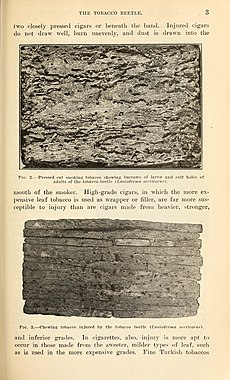
Tobacco, aslope its related products, can be infested past parasites such as the Lasioderma serricorne (tobacco beetle) and the Ephestia elutella (tobacco moth), which are the nigh widespread and damaging parasites to the tobacco manufacture.[28] Infestation can range from the tobacco cultivated in the fields to the leaves used for manufacturing cigars, cigarillos, cigarettes, etc.[28] Both the larvae of Lasioderma serricorne and caterpillars of Ephestia elutella are considered a pest.[28]
Production [edit]
Cultivation [edit]
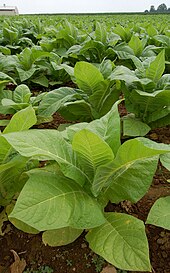
Tobacco is cultivated similarly to other agricultural products. Seeds were at first quickly scattered onto the soil. However, young plants came under increasing set on from flea beetles (Epitrix cucumeris or E. pubescens), which caused devastation of one-half the tobacco crops in United States in 1876. By 1890, successful experiments were conducted that placed the plant in a frame covered past thin cotton fabric. Today, tobacco seeds are sown in cold frames or hotbeds, every bit their germination is activated by light.[29] In the United States, tobacco is ofttimes fertilized with the mineral apatite, which partially starves the plant of nitrogen, to produce a more than desired season.
Later on the plants are well-nigh eight inches (xx cm) tall, they are transplanted into the fields. Farmers used to accept to wait for rainy conditions to establish. A pigsty is created in the tilled earth with a tobacco peg, either a curved wooden tool or deer antler. Afterwards making 2 holes to the right and left, the planter would move forward two feet, select plants from his/her bag, and repeat. Diverse mechanical tobacco planters like Bemis, New Idea Setter, and New Holland Transplanter were invented in the late 19th and 20th centuries to automate the process: making the hole, watering information technology, guiding the establish in — all in one move.[thirty]
Tobacco is cultivated annually, and can be harvested in several ways. In the oldest method, withal used today, the unabridged plant is harvested at once by cutting off the stalk at the footing with a tobacco knife; it is and then speared onto sticks, four to 6 plants a stick, and hung in a curing barn. In the 19th century, bright tobacco began to exist harvested by pulling individual leaves off the stalk as they ripened. The leaves ripen from the ground upwards, so a field of tobacco harvested in this manner entails the series harvest of a number of "primings", beginning with the volado leaves near the ground, working to the seco leaves in the middle of the establish, and finishing with the potent ligero leaves at the superlative. Before harvesting, the crop must be topped when the pink flowers develop. Topping ever refers to the removal of the tobacco flower before the leaves are systematically harvested. As the industrial revolution took hold, the harvesting wagons which were used to transport leaves were equipped with man-powered stringers, an apparatus that used twine to attach leaves to a pole. In modernistic times, large fields are harvested mechanically, although topping the flower and in some cases the plucking of immature leaves is still washed by hand.
In the U.S., Due north Carolina and Kentucky are the leaders in tobacco production, followed by Tennessee, Virginia, Georgia, S Carolina and Pennsylvania.[31]
Curing [edit]

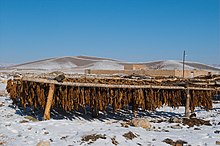
Curing and subsequent aging allow for the slow oxidation and degradation of carotenoids in tobacco leaf. This produces certain compounds in the tobacco leaves and gives a sweet hay, tea, rose oil, or fruity effluvious flavor that contributes to the "smoothness" of the fume. Starch is converted to sugar, which glycates protein, and is oxidized into advanced glycation endproducts (AGEs), a caramelization process that as well adds flavor. Inhalation of these AGEs in tobacco smoke contributes to atherosclerosis and cancer.[32] Levels of AGEs are dependent on the curing method used.
Tobacco can be cured through several methods, including:
- Air-cured tobacco is hung in well-ventilated barns and allowed to dry over a period of four to eight weeks. Air-cured tobacco is depression in carbohydrate, which gives the tobacco smoke a light, balmy flavor, and high in nicotine. Cigar and burley tobaccos are 'night' air-cured.[33]
- Fire-cured tobacco is hung in large barns where fires of hardwoods are kept on continuous or intermittent low smoulder, and takes betwixt three days and 10 weeks, depending on the procedure and the tobacco. Burn curing produces a tobacco low in sugar and loftier in nicotine. Piping tobacco, chewing tobacco, and snuff are burn-cured.
- Flue-cured tobacco was originally strung onto tobacco sticks, which were hung from tier poles in curing barns (Aus: kilns, also traditionally called 'oasts'). These barns accept flues run from externally fed fire boxes, estrus-curing the tobacco without exposing it to smoke, slowly raising the temperature over the grade of the curing. The process generally takes nigh a week. This method produces cigarette tobacco that is high in sugar and has medium to loftier levels of nicotine. Most cigarettes incorporate flue-cured tobacco, which produces a milder, more inhalable smoke. It is estimated that one tree is cutting to flue-cure every 300 cigarettes, resulting in serious environmental consequences.[34]
- Sun-cured tobacco dries uncovered in the sun. This method is used in Turkey, Hellenic republic, and other Mediterranean countries to produce oriental tobacco. Sun-cured tobacco is low in saccharide and nicotine and is used in cigarettes.
Some tobaccos go through a second stage of curing, known as fermenting or sweating.[35] Cavendish undergoes fermentation pressed in a casing solution containing carbohydrate and/or flavoring.[36]
Global product [edit]

Tobacco production, 2018[37]
Trends [edit]

Product of tobacco leafage increased by forty% betwixt 1971, when 4.2 million tons of leaf were produced, and 1997, when 5.9 million tons of leaf were produced.[38] According to the Food and Agriculture organization of the UN, tobacco leafage product was expected to hit 7.1 meg tons by 2010. This number is a chip lower than the record-high product of 1992, when seven.5 million tons of leafage were produced.[39] The production growth was almost entirely due to increased productivity past developing nations, where production increased past 128%.[40] During that same time, production in adult countries actually decreased.[39] China's increase in tobacco production was the single biggest gene in the increase in earth production. Cathay's share of the globe market increased from 17% in 1971 to 47% in 1997.[38] This growth can be partially explained past the being of a depression import tariff on foreign tobacco entering Communist china. While this tariff has been reduced from 66% in 1999 to x% in 2004,[41] information technology still has led to local, Chinese cigarettes existence preferred over strange cigarettes because of their lower toll.
Major producers [edit]
| Elevation tobacco producers, 2017[42] | ||||
|---|---|---|---|---|
| Country | Production (tonnes) | Note | ||
 Cathay Cathay | 2,391,000 | |||
 Brazil Brazil | 880,881 | |||
 Bharat Bharat | 799,960 | F | ||
 United States United States | 322,120 | |||
 Zimbabwe Zimbabwe | 181,643 | F | ||
 Indonesia Indonesia | 152,319 | |||
 Zambia Zambia | 131,509 | F | ||
 Islamic republic of pakistan Islamic republic of pakistan | 117,750 | F | ||
 Argentina Argentina | 117,154 | |||
 Tanzania Tanzania | 104,471 | F | ||
| World | 6,501,646 | A | ||
| No annotation = official figure, F = FAO Estimate, A = Amass (may include official, semiofficial or estimates). | ||||
Every year, about 6.7 million tons of tobacco are produced throughout the world. The top producers of tobacco are China (39.half-dozen%), India (8.3%), Brazil (vii.0%) and the United States (iv.six%).[43]
China [edit]
Around the acme of global tobacco production, 20 million rural Chinese households were producing tobacco on ii.1 one thousand thousand hectares of country.[44] While it is the major ingather for millions of Chinese farmers, growing tobacco is not as profitable as cotton or sugarcane, because the Chinese government sets the market price. While this price is guaranteed, information technology is lower than the natural market price, because of the lack of market adventure. To further command tobacco in their borders, Mainland china founded a State Tobacco Monopoly Assistants (STMA) in 1982. The STMA controls tobacco production, marketing, imports, and exports, and contributes 12% to the nation's national income.[45] As noted above, despite the income generated for the state by profits from state-owned tobacco companies and the taxes paid past companies and retailers, China's regime has acted to reduce tobacco use.[46]
India [edit]
India's Tobacco Board is headquartered in Guntur in the land of Andhra Pradesh.[47] Bharat has 96,865 registered tobacco farmers[48] and many more who are non registered. In 2010, 3,120 tobacco product manufacturing facilities were operating in all of Bharat.[49] Around 0.25% of Republic of india'south cultivated land is used for tobacco production.[l]
Since 1947, the Indian government has supported growth in the tobacco industry. Republic of india has seven tobacco research centers, located in Tamil Nadu, Andhra Pradesh, Punjab, Bihar, Mysore, and W Bengal houses the core inquiry institute.
Brazil [edit]
In Brazil, effectually 135,000 family farmers cite tobacco production equally their main economic action.[44] Tobacco has never exceeded 0.7% of the country's total cultivated expanse.[51] In the southern regions of Brazil, Virginia, and Amarelinho, flue-cured tobacco, every bit well as burley and Galpão Comum air-cured tobacco, are produced. These types of tobacco are used for cigarettes. In the northeast, darker, air- and sun-cured tobacco is grown. These types of tobacco are used for cigars, twists, and dark cigarettes.[51] Brazil's regime has made attempts to reduce the product of tobacco but has not had a successful systematic antitobacco farming initiative. Brazil'south government, however, provides small loans for family unit farms, including those that grow tobacco, through the Programa Nacional de Fortalecimento da Agricultura Familiar.[52]
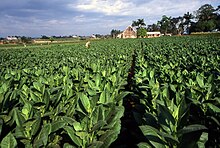
Problems in production [edit]
Kid labor [edit]
The International Labour Office reported that the most child-laborers piece of work in agriculture, which is i of the most chancy types of work.[53] [ failed verification – run across discussion] The tobacco industry houses some of these working children. Apply of children is widespread on farms in Brazil, Prc, Republic of india, Indonesia, Malawi, and Zimbabwe.[54] While some of these children piece of work with their families on small, family-owned farms, others work on big plantations. In belatedly 2009, reports were released by the London-based homo-rights group Programme International, claiming that child labor was common on Malawi (producer of one.eight% of the world's tobacco[38]) tobacco farms. The organization interviewed 44 teens, who worked full-time on farms during the 2007-8 growing flavor. The child-laborers complained of low pay and long hours, too as physical and sexual abuse by their supervisors.[55] They also reported suffering from Green tobacco sickness, a form of nicotine poisoning. When wet leaves are handled, nicotine from the leaves gets absorbed in the skin and causes nausea, airsickness, and dizziness. Children were exposed to levels of nicotine equivalent to smoking 50 cigarettes, merely through direct contact with tobacco leaves. This level of nicotine in children can permanently modify brain structure and part.[53] [ failed verification – come across discussion]
Economy [edit]
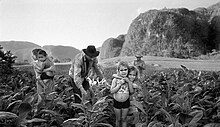
Major tobacco companies have encouraged global tobacco production. Philip Morris, British American Tobacco, and Nihon Tobacco each own or lease tobacco-manufacturing facilities in at least 50 countries and buy crude tobacco foliage from at least 12 more countries.[56] This encouragement, along with government subsidies, has led to a glut in the tobacco market. This surplus has resulted in lower prices, which are devastating to small-scale tobacco farmers. According to the Earth Bank, betwixt 1985 and 2000, the inflation-adjusted price of tobacco dropped 37%.[57] Tobacco is the almost widely smuggled legal production.[58]
Environs [edit]
Tobacco production requires the use of large amounts of pesticides. Tobacco companies recommend up to 16 carve up applications of pesticides just in the period between planting the seeds in greenhouses and transplanting the immature plants to the field.[59] Pesticide use has been worsened past the desire to produce larger crops in less fourth dimension considering of the decreasing marketplace value of tobacco. Pesticides often harm tobacco farmers because they are unaware of the health effects and the proper safety protocol for working with pesticides. These pesticides, as well as fertilizers, end up in the soil, waterways, and the food chain.[lx] Coupled with child labor, pesticides pose an even greater threat. Early exposure to pesticides may increment a child's lifelong cancer risk, too as damage his or her nervous and allowed systems.[61]
As with all crops, tobacco crops excerpt nutrients (such equally phosphorus, nitrogen, and potassium) from soil, decreasing its fertility.[62]
Furthermore, the wood used to cure tobacco in some places leads to deforestation. While some big tobacco producers such as China and the U.s.a. have access to petroleum, coal, and natural gas, which can exist used equally alternatives to wood, most developing countries withal rely on forest in the curing process.[62] Brazil alone uses the wood of 60 one thousand thousand trees per year for curing, packaging, and rolling cigarettes.[59]
In 2017 WHO released a study on the environmental effects of tobacco.[63]
Research [edit]
Several tobacco plants accept been used as model organisms in genetics. Tobacco Past-2 cells, derived from Due north. tabacum cultivar 'Bright Yellow-2', are amidst the nearly important inquiry tools in plant cytology.[64] Tobacco has played a pioneering role in callus culture inquiry and the elucidation of the mechanism past which kinetin works, laying the groundwork for modern agronomical biotechnology. The first genetically modified constitute was produced in 1982, using Agrobacterium tumefaciens to create an antibody-resistant tobacco constitute.[65] This enquiry laid the groundwork for all genetically modified crops.[66]
Genetic modification [edit]
Because of its importance as a enquiry tool, transgenic tobacco was the start GM crop to exist tested in field trials, in the United States and French republic in 1986; Red china became the first country in the world to approve commercial planting of a GM crop in 1993, which was tobacco.[67]
Field trials [edit]
Many varieties of transgenic tobacco have been intensively tested in field trials. Agronomic traits such as resistance to pathogens (viruses, particularly to the tobacco mosaic virus (TMV); fungi; bacteria and nematodes); weed direction via herbicide tolerance; resistance against insect pests; resistance to drought and cold; and production of useful products such equally pharmaceuticals; and use of GM plants for bioremediation, have all been tested in over 400 field trials using tobacco.[68]
Production [edit]
Currently, merely the US is producing GM tobacco.[67] [68] The Chinese virus-resistant tobacco was withdrawn from the market in Mainland china in 1997.[69] : 3 From 2002 to 2010, cigarettes made with GM tobacco with reduced nicotine content were available in the US under the marketplace name Quest.[68] [70]
Consumption [edit]
Tobacco is consumed in many forms and through a number of different methods. Some examples are:
- Beedi (also known as bidis or biris) are thin, often flavoured cigarettes from Bharat fabricated of tobacco wrapped in a tendu leaf, and secured with coloured thread at i end.[71]
- Chewing tobacco is the oldest way of consuming tobacco leaves. It is consumed orally, in two forms: through sweetened strands ("chew" or "chaw"), or in a shredded form ("dip"). When consuming the long, sweetened strands, the tobacco is lightly chewed and compacted into a ball. When consuming the shredded tobacco, minor amounts are placed at the bottom lip, between the mucilage and the teeth, where it is gently compacted, thus it can often exist called dipping tobacco. Both methods stimulate the salivary glands, which led to the development of the spittoon.
- Cigars are tightly rolled bundles of dried and fermented tobacco, which are ignited so their smoke may exist fatigued into the smokers' mouths.
- Cigarettes are a production consumed through inhalation of smoke and manufactured from cured and finely cut tobacco leaves and reconstituted tobacco, often combined with other additives, then rolled into a paper cylinder.
- Creamy snuff is tobacco paste, consisting of tobacco, clove oil, glycerin, spearmint, menthol, and camphor, and sold in a toothpaste tube. It is marketed mainly to women in Republic of india, and is known by the brand names Ipco (made by Asha Industries), Denobac, Tona, and Ganesh. It is locally known as mishri in some parts of Maharashtra.
- Dipping tobaccos are a form of smokeless tobacco. Dip is occasionally referred to as "chew", and because of this, it is ordinarily dislocated with chewing tobacco, which encompasses a wider range of products. A small clump of dip is 'pinched' out of the tin and placed between the lower or upper lip and gums. Some brands, equally with snus, are portioned in small, porous pouches for less mess.
- Gutka is a grooming of crushed betel nut, tobacco, and sweet or savory flavorings. It is manufactured in India and exported to a few other countries. A mild stimulant, it is sold across India in pocket-sized, individual-sized packets.
- Oestrus-not-burn products heat rather than burn down tobacco to generate an droplets that contains nicotine.
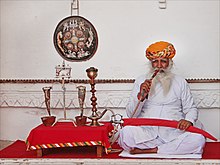
- Dokha is a middle eastern tobacco with high nicotine levels grown in parts of Oman and Hatta, which is smoked through a thin pipage called a medwakh. Information technology is a form of tobacco which is dried up and ground and contains fiddling to no additives excluding spices, fruits, or flowers to heighten smell and flavor.
- Hookah is a single- or multistemmed (often glass-based) h2o pipe for smoking. Hookahs were first used in Bharat and Persia;[72] the hookah has gained immense popularity, especially in the Heart East. A hookah operates past water filtration and indirect heat. Information technology can exist used for smoking herbal fruits or moassel, a mixture of tobacco, flavouring, and dear or glycerin.
- Kreteks are cigarettes made with a complex alloy of tobacco, cloves, and a flavoring "sauce". They were start introduced in the 1880s in Kudus, Coffee, to evangelize the medicinal eugenol of cloves to the lungs.
- Coil-your-own, often called 'rollies' or 'roll-ups', are relatively pop in some European countries. These are prepared from loose tobacco, cigarette papers, and filters all bought separately. They are ordinarily cheaper to make.
- Snuff is a ground smokeless tobacco product, inhaled or "snuffed" through the nose. If referring specifically to the orally consumed moist snuff, see dipping tobacco.
- Snus is a steam-pasteurized moist powdered tobacco product that is not fermented, and induces minimal salivation. Information technology is consumed by placing it (loose or in little pouches) against the upper gums for an extended catamenia of time. Information technology is somewhat similar to dipping tobacco just does non require spitting and is significantly lower in TSNAs.
- Tobacco edibles, often in the form of an infusion or a spice, have gained popularity in recent years.
- Tobacco pipes typically consist of a pocket-size chamber (the bowl) for the combustion of the tobacco to be smoked and a sparse stem (shank) that ends in a mouthpiece (the flake). Shredded pieces of tobacco are placed in the sleeping accommodation and ignited.
- Tobacco smoke enemas were employed by the ethnic peoples of North America to stimulate respiration, injecting the fume with a rectal tube.[73] [74] [75] [76] Later on, in the 18th century, Europeans emulated the Americans.[77] Tobacco resuscitation kits consisting of a pair of bellows and a tube were provided by the Imperial Humane Society of London and placed at diverse points forth the Thames.[78]
- Tobacco h2o is a traditional organic insecticide used in domestic gardening. Tobacco dust can be used similarly. It is produced past humid strong tobacco in water, or by steeping the tobacco in h2o for a longer period. When cooled, the mixture can exist practical equally a spray, or 'painted' on to the leaves of garden plants, where it kills insects. Tobacco is, nevertheless, banned from use as pesticide in certified organic production past the USDA's National Organic Program.[79]
- Topical tobacco paste is sometimes used as a treatment for wasp, hornet, burn ant, scorpion, and bee stings.[80] An amount equivalent to the contents of a cigarette is mashed in a cup with nigh a one-half a teaspoon of water to make a paste that is then applied to the afflicted area.
Impact [edit]
[edit]
Smoking in public was, for a long time, reserved for men, and when done by women was sometimes associated with promiscuity; in Japan, during the Edo catamenia, prostitutes and their clients often approached one another nether the guise of offering a smoke. The same was truthful in 19th-century Europe.[81]
Post-obit the American Civil State of war, the employ of tobacco, primarily in cigars, became associated with masculinity and ability. Today, tobacco use is often stigmatized; this has spawned quitting associations and antismoking campaigns.[82] [83] Bhutan is the only state in the earth where tobacco sales are illegal.[84] Due to its propensity for causing detumescence and erectile dysfunction, some studies take described tobacco as an anaphrodisiacal substance.[85]
Faith [edit]
Christianity [edit]
In Christian denominations of the conservative holiness movement, such as the Allegheny Wesleyan Methodist Connectedness and Evangelical Wesleyan Church, the employ of tobacco and other drugs is prohibited;[86] : 37 ¶42 of the 2014 Book of Bailiwick of the Allegheny Wesleyan Methodist Connection states:[86] [ page needed ]
In the judgment of The Allegheny Wesleyan Methodist Connection (Original Allegheny Briefing), the use of tobacco is a swell evil, unbecoming a Christian, a waste of the Lord's money, and a defilement of the body, which should be the temple of the Holy Ghost. Nosotros practise, therefore, most earnestly require our members to refrain from its cultivation, industry, and sale, and to abjure from its use in all forms, for Jesus' sake. We volition not receive every bit members into our churches nor will we ordain or license to preach or to exhort, persons who use, cultivate, industry, or sell tobacco. Using tobacco by a member of a church or of the Conference subsequently being received from this date (June 28, 1927) is a violation of the police of the church building, and the offending party should be dealt with according to the judiciary rules.[86] : 44
Islam [edit]
Sikhism [edit]
Sikhism, a monotheistic religion from India, considers tobacco consumption every bit a taboo and very bad for health and spirituality. Initiated Sikhs are never to eat tobacco in any form.[87]
Demographic [edit]
Research on tobacco utilize is limited mainly to smoking, which has been studied more extensively than any other grade of consumption. An estimated 1.1 billion people, and up to ane-third of the adult population, use tobacco in some form.[88] Smoking is more than prevalent amongst men[89] (however, the gender gap declines with age),[90] [91] the poor, and in transitional or developing countries.[92] A report published in Morbidity and Mortality Weekly Written report found that in 2019 approximately i in four youths (23.0%) in the U.S. had used a tobacco production during the past 30 days. This represented approximately three in ten high schoolhouse students (31.2%) and approximately 1 in eight middle school students (12.5%).[93]
Rates of smoking proceed to rise in developing countries, merely have leveled off or declined in adult countries.[94] Smoking rates in the United States accept dropped by half from 1965 to 2006, falling from 42% to 20.eight% in adults.[95] In the developing world, tobacco consumption is ascent by three.4% per year.[96]
Health furnishings [edit]
Chemicals [edit]
Tobacco smoking harms health considering of the toxic chemicals in tobacco smoke, including carbon monoxide, cyanide, and carcinogens, which take been proven to crusade heart and lung diseases and cancer. Thousands of different substances in cigarette fume, including polycyclic aromatic hydrocarbons (such as benzopyrene), formaldehyde, cadmium, nickel, arsenic, tobacco-specific nitrosamines, and phenols contribute to the harmful effects of smoking.[97]
According to the World Health Organization, tobacco is the single greatest cause of preventable death globally.[98] WHO estimates that tobacco acquired 5.4 million deaths in 2004[99] and 100 1000000 deaths over the course of the 20th century.[100] Similarly, the U.s. Centers for Affliction Command and Prevention describe tobacco utilise as "the single nigh important preventable gamble to human health in adult countries and an important cause of premature death worldwide."[101] Due to these health consequences, it is estimated that a ten hectare (approximately 24.7 acre) field of tobacco used for cigarettes causes xxx deaths per year – 10 from lung cancer and 20 from cigarette-induced diseases like cardiac arrest, gangrene, bladder cancer, mouth cancer, etc.[102]
The harms caused past inhaling tobacco fume include diseases of the eye and lungs, with smoking existence a major risk factor for heart attacks, strokes, chronic obstructive pulmonary disease (emphysema), and cancer (particularly cancers of the lungs, larynx, oral cavity, and pancreas). Cancer is caused past inhaling carcinogenic substances in tobacco smoke.
Inhaling secondhand tobacco smoke (which has been exhaled by a smoker) can cause lung cancer in nonsmoking adults. In the United States, about iii,000 adults die each yr due to lung cancer from secondhand smoke exposure. Heart disease caused by secondhand smoke kills around 46,000 nonsmokers every year.[103]
In children, exposure to secondhand tobacco smoke is associated with a higher incidence and severity of respiratory illnesses, middle ear disease, and asthma attacks. Each year in the Usa, secondhand fume exposure causes 24,500 infants to be born with low birthweight, 71,900 preterm births, 202,300 episodes of asthma, and 790,00 wellness care visits for ear infections.[104]
The addictive alkaloid nicotine is a stimulant, and popularly known equally the most characteristic elective of tobacco. In drug effect preference questionnaires, a rough indicator of addictive potential, nicotine scores most as highly every bit opioids.[105] Users typically develop tolerance and dependence.[106] [107] Nicotine is known to produce conditioned place preference, a sign of psychological enforcement value.[108] In i medical study, tobacco's overall harm to user and self was determined at iii percent below cocaine, and 13 percent above amphetamines, ranking 6th about harmful of the 20 drugs assessed.[109]
Radioactivity [edit]
Polonium-210 is a radioactive trace contaminant of tobacco, providing additional explanation for the link between smoking and bronchial cancer.[110] The radioactive particles build upwards over time in the lungs and a UCLA report has estimated that the radiation from 25 years of smoking would cause over 120 deaths per yard smokers.[111]
Economic [edit]
![[icon]](https://upload.wikimedia.org/wikipedia/commons/thumb/1/1c/Wiki_letter_w_cropped.svg/20px-Wiki_letter_w_cropped.svg.png) | This section needs expansion with: discussion of the impact on the poor, taxation, and so forth. Yous tin help by adding to it. (January 2009) |
Tobacco has a meaning economic impact. The global tobacco market place in 2010 was estimated at US$760 billion, excluding China.[112] The global revenues from tobacco taxes in 2013-2014 was approximately $269 billion.
In China, cigarette manufacturing is 1 of the few assisting state-owned industries. For example, in 1998 the ane 429 land-owned enterprises in Yunnan province had revenue of Renminbi (RMB) 69.i billion (US$8.three billion) while 8 cigarette manufacturing plants alone deemed for most 53 pct (or RMB 36.2 billion) of full provincial industry sales.[113] The Chinese government also collects taxation on tobacco products. Tax revenues from cigarettes increased from 740 to 842 billion Chinese yuan between 2014 and 2016. This generated an boosted 101 billion Chinese yuan in revenue enhancement revenues for the government.[114]
In India, tobacco generates approximately 20 billion Indian Rupees (The states$0.45 billion) of income per annum equally a result of employment, income and government revenue.[115]
Statistica estimates that in the U.Due south. alone, the tobacco manufacture has a market of U.s.a.$121 billion,[116] despite the fact the CDC reports that U.s. smoking rates are failing steadily.[117] In terms of health expenditures, cigarette smoking contributed to more than $225 billion (or xi.7%) of annual healthcare spending in the U.S. in 2014.[118] Smoking-attributable healthcare spending increased more than 30% for Medicaid betwixt 2010 and 2014.[118]
In the United states, the decline in the number of smokers, the finish of the Tobacco Transition Payment Program in 2014, and competition from growers in other countries, made tobacco farming economics more than challenging.[119]
Of the 1.22 billion smokers worldwide, 1 billion of them live in developing or transitional economies, and much of the disease brunt and premature mortality attributable to tobacco use disproportionately affect the poor.[92] While smoking prevalence has declined in many developed countries, information technology remains loftier in others, and is increasing amid women and in developing countries. Between one-fifth and two-thirds of men in most populations smoke. Women's smoking rates vary more widely but rarely equal male person rates.[120]
In Indonesia, the everyman income group spends 15% of its total expenditures on tobacco. In Egypt, more than 10% of depression-income household expenditure is on tobacco. The poorest 20% of households in United mexican states spend 11% of their income on tobacco.[121]
Advertizement [edit]
The tobacco industry advertises its products through a variety of media, including sponsorship, particularly of sporting events. Because of the health risks of these products, this is at present ane of the about highly regulated forms of marketing. Some or all forms of tobacco advertizement are banned in many countries.[ citation needed ]
Legality [edit]
Run into as well [edit]
- Biorefining of tobacco
- List of tobacco-related topics
- Inquiry about cure of asthma and Bronchodilatation
References [edit]
- ^ "The states votes to enhance age for ownership tobacco — including eastward-cigs — from 18 to 21". The Verge . Retrieved Jan xiii, 2019.
- ^ Howard, Jacqueline. "The Usa officially raises the tobacco ownership historic period to 21". CNN . Retrieved Jan 14, 2020.
- ^ Rudgley, Richard. "Tobacco: from The Encyclopedia of Psychoactive Substances". Biopsychiatry. Footling, Brown and Company (1998). Retrieved November 26, 2017.
- ^ "WHO Report on the global tobacco epidemic, 2008 (foreword and summary)" (PDF). Globe Health Organization. 2008. p. 8. Archived from the original (PDF) on February 15, 2008.
Tobacco is the single nearly preventable cause of expiry in the world today.
- ^ a b Ernst, A. (1889). "On the etymology of the discussion tobacco". The American Anthropologist. A2 (2): 133–142. doi:10.1525/aa.1889.2.ii.02a00020.
- ^ "World Association of International Studies, Stanford University".
- ^ Lane'southward Lexicon. folio 1879.
- ^ The word ṭubāq no longer refers to diverse herbs, but has come to refer, in some dialects, specifically to tobacco. See Hans Wehr'south Dictionary of Modern Written Arabic. page 647.
- ^ Goodman, Jordan. Tobacco in History and Culture: An Encyclopedia (Detroit: Thomson Gale, 2005).
- ^ eastward.m. Heckewelder, History, Manners and Customs of the Indian Nations who One time Inhabited Pennsylvania, p. 149 ff.
- ^ "They fume with excessive eagerness ... men, women, girls and boys, all notice their keenest pleasure in this way." - Dièreville describing the Mi'kmaq, circa 1699 in Port Regal.
- ^ Jack Jacob Gottsegen, Tobacco: A Study of Its Consumption in the United States, 1940, p. 107.
- ^ Appleby, Joyce (2010). The Relentless Revolution: A History of Capitalism. W.W. Norton & Company. p. 131.
- ^ Harriot, Thomas, A Brief and Truthful Written report of the New Found Land of Virginia, 1590, http://www.gutenberg.org/files/4247/4247-h/4247-h.htm
- ^ Eric Burns, The Smoke of the Gods: A Social History of Tobacco (2006), A popular history focused on the US.
- ^ Jordan Goodman, Tobacco in History: The Cultures of Dependence (1993), A scholarly history worldwide.
- ^ Charlotte Cosner, The Aureate Leaf: How Tobacco Shaped Cuba and the Atlantic World (Vanderbilt University Press; 2015)
- ^ Richard Kluger, Ashes to Ashes: America's Hundred-Year Cigarette War (1996)
- ^ Allan Brandt, The Cigarette Century: The Ascent, Fall, and Deadly Persistence of the Product That Divers America (2007)
- ^ Commissioner, Office of the (September 9, 2020). "Want to Quit Smoking? FDA-Approved Products Can Help". FDA.
- ^ "WHO | WHO Framework Convention on Tobacco Command (WHO FCTC)". Who.int. Archived from the original on May 27, 2008. Retrieved September 18, 2008.
- ^ "WHO | WHO Framework Convention on Tobacco Control". WHO. Retrieved February 17, 2021.
- ^ Yang, Haiyang; Ma, Jingjing (August 1, 2021). "How the COVID-19 pandemic impacts tobacco addiction: Changes in smoking behavior and associations with well-beingness". Addictive Behaviors. 119: 106917. doi:10.1016/j.addbeh.2021.106917. ISSN 0306-4603. PMID 33862579.
- ^ Lewis, Albert (1931). "Tobacco in New Guinea". The American Anthropologist. 33 (one): 134–139. doi:10.1525/aa.1931.33.1.02a00290.
- ^ Panter, KE; Keeler, RF; Bunch, TD; Callan, RJ (1990). "Congenital skeletal malformations and cleft palate induced in goats by ingestion of Lupinus, Conium and Nicotiana species". Toxicon. 28 (12): 1377–1385. doi:x.1016/0041-0101(90)90154-Y. PMID 2089736.
- ^ Elsey, K. D.; Rabb, R. L. (December ane, 1967). "Biological science of the Cabbage Looper on Tobacco In North Carolina1". Periodical of Economical Entomology. 60 (half-dozen): 1636–1639. doi:10.1093/jee/sixty.6.1636. ISSN 0022-0493.
- ^ [ane], Broadleaf tobacco, Tobacco University
- ^ a b c Ryan, L., ed. (1995). "Introduction". Post-harvest Tobacco Infestation Command. Norwell, Massachusetts and Dordrecht, Netherlands: Kluwer Academic Publishers. pp. 1–4. doi:x.1007/978-94-017-2723-5_1. ISBN978-94-017-2723-5.
- ^ Garner, W. W. (Feb 27, 1914). "Tobacco Culture". Farmers' Bulletin. United States Department of Agronomics (571): 3–4. Retrieved March 22, 2020.
- ^ van Willigen, John; Eastwood, Susan (2015). Tobacco Culture: Farming Kentucky's Burley Belt. University Press of Kentucky. p. 91. ISBN9780813148083 . Retrieved February 2, 2018.
- ^ "USDA/NASS QuickStats Ad-hoc Query Tool". quickstats.nass.usda.gov. 2019. Retrieved July i, 2020.
- ^ Cerami C, Founds H, Nicholl I, Mitsuhashi T, Giordano D, Vanpatten S, Lee A, Al-Abed Y, Vlassara H, Bucala R, Cerami A (1997). "Tobacco smoke is a source of toxic reactive glycation products". Proceedings of the National Academy of Sciences of the United States of America. 94 (25): 13915–xx. Bibcode:1997PNAS...9413915C. doi:10.1073/pnas.94.25.13915. PMC28407. PMID 9391127.
- ^ "tobacco curing." The Hutchinson Unabridged Encyclopedia with Atlas and Weather guide. Abington: Helicon, 2010. Credo Reference. Spider web. September 26, 2012.
- ^ Organization, World Health (2017). Tobacco and its environmental touch: an overview. World Health Organization. [Geneva, Switzerland?]. ISBN9789241512497. OCLC 988541317.
- ^ "Tobacco Foliage Harvesting, Curing, and Fermenting". Leaf But . Retrieved April twenty, 2017.
- ^ "Pipe Tobacco". Archived from the original on Oct 17, 2013. Retrieved Apr 20, 2017.
- ^ "Tobacco product". Our World in Data . Retrieved March 7, 2020.
- ^ a b c Food and Agriculture System of the United Nations. "Projection of tobacco production, consumption and trade for the year 2010." Rome, 2003.
- ^ a b The Food and Agriculture Arrangement of the United Nations.College World Tobacco utilise expected past 2010-growth rates slowing down. (Rome, 2004).
- ^ Rowena Jacobs; et al. (2000). "The Supply-Side Effects Of Tobacco Control Policies". In Prabhat Jha; Frank J. Chaloupka (eds.). Tobacco Control in Developing Countries. New York: Oxford University Press. pp. 311ff. ISBN978-0-xix-263250-0.
- ^ Hu, T-W; Mao, Z; et al. (2006). "China at the Crossroads: The Economic science of Tobacco and Health". Tobacco Control. 15: i37–i41. doi:10.1136/tc.2005.014621. PMC2563551. PMID 16723674.
- ^ "FAOSTAT". Food And Agriculture Organization Of The Un. Retrieved November 3, 2019.
- ^ U.s.a. Census Bureau-Strange Trade Statistics, (Washington DC; 2005)
- ^ a b Food and Agriculture Organization of the United Nations. "Issues in the Global Tobacco Economy."
- ^ "People's Republic of Cathay. "Land Tobacco Monopoly Administration". Gov.cn. September 15, 2005. Archived from the original on August 10, 2013. Retrieved Oct 3, 2013.
- ^ USC U.S.-China Found, "Talking Points, February 3–17, 2010: http://people's republic of china.usc.edu/ShowArticle.aspx?articleID=1992
- ^ "Tobacco Board, Guntur". Tobaccoboard.com. Retrieved April 21, 2014.
- ^ Shoba, John and Shailesh Vaite. Tobacco and Poverty: Observations from Republic of india and People's republic of bangladesh. Canada, 2002.
- ^ "Tobacco Manufacturing in India".
- ^ three.Food and Agriculture Organization of the United nations. "Issues in the Global Tobacco Economy."
- ^ a b International Tobacco Growers' Clan (n.d.). Tobacco farming: sustainable alternatives? Volume 2 (PDF). East Sussex: ITGA. ISBN978-1872854021. Archived from the original (PDF) on April 29, 2017. Retrieved July five, 2016.
- ^ High Level Commission on Legal Empowerment of the Poor. "Written report from South America." 2006.
- ^ a b ILO. International Hazard Datasheets on Occupations: Field Crop Worker
- ^ UNICEF, The State of the World'due south Children 1997 (Oxford, 1997); US Department of Agriculture By the Sweat and Toil of Children Volume Two: The Use of Kid Labor in The states Agricultural Imports & Forced and Bonded Child Labor (Washington, 1995); ILO Bitter Harvest: Child Labour in Agriculture (Geneva, 1997); ILO Child Labour on Commercial Agriculture in Africa (Geneva 1997)
- ^ Plan International. Malawi Child Tobacco Pickers' '50-a-day habit http://programme-international.org/nigh-programme/resources/media-eye/printing-releases/malawi-child-tobacco-pickers-50-a-day-addiction/?searchterm=tobacco
- ^ "International Cigarette Manufacturers," Tobacco Reporter, March 2001
- ^ The Campaign for Tobacco Free Kids (November 2001). "Golden Leaf, Arid Harvest: The Costs of Tobacco Farming" (PDF). Archived from the original (PDF) on April six, 2013.
- ^ "Tobacco Secret". The International Consortium of Investigative Journalists . Retrieved November 26, 2012.
- ^ a b Taylor, Peter (September 1994). Fume Ring: The Politics of Tobacco. London: Panos Briefing Paper.
- ^ FAO Yearbook, Production, Volume 48. 1995.
- ^ National Enquiry Council (1995). Pesticides in the Diets of Infants and Children. National Academy Press.
- ^ a b World Wellness Organization. "Tobacco Free Initiative: Ecology issues". Archived from the original on December 19, 2004.
- ^ Organization, Earth Health (2017). Tobacco and its ecology impact: an overview. World Health Arrangement. ISBN978-92-4-151249-vii. Archived from the original on May 31, 2017.
- ^ Ganapathi TR; et al. (2004). "Tobacco (Nicotiana tabacum 50.) – A model system for tissue culture interventions and genetic engineering" (PDF). Indian Periodical of Biotechnology. 3: 171–184.
- ^ Fraley RT; et al. (1983). "Expression of bacterial genes in plant cells". Proc. Natl. Acad. Sci. U.s.A. eighty (15): 4803–4807. Bibcode:1983PNAS...lxxx.4803F. doi:ten.1073/pnas.80.fifteen.4803. PMC384133. PMID 6308651.
- ^ "Scientific discipline of Transgenic Cotton wool". Cottoncrc.org.au. Archived from the original on March 21, 2012. Retrieved October 3, 2013.
- ^ a b James, Clive (1996). "Global Review of the Field Testing and Commercialization of Transgenic Plants: 1986 to 1995" (PDF). The International Service for the Acquisition of Agri-biotech Applications. Retrieved July 17, 2010.
- ^ a b c "Tobacco". GMO Compass. Archived from the original on October 2, 2013. Retrieved October iii, 2013.
- ^ Conner AJ, Glare TR, Nap JP (January 2003). "The release of genetically modified crops into the environment. Part Ii. Overview of ecological risk assessment". Plant J. 33 (one): 19–46. doi:10.1046/j.0960-7412.2002.001607.10. PMID 12943539.
- ^ Rubin, Rita. "If You Took The Nicotine Out Of Cigarettes, Would Fewer People Desire To Smoke?". Forbes . Retrieved May 3, 2019.
- ^ Tobacco Costless Kids (2008). "Bidis: An Overview" (PDF). Tobacco Free Kids . Retrieved October 27, 2021.
- ^ American Lung Association. Feb 2007 An Emerging Deadly Trend: Waterpipe Tobacco Use Archived Jan ii, 2014, at the Wayback Machine
- ^ Hurt, Raymond; Barry, J. Due east.; Adams, A. P.; Fleming, P. R. (1996), The History of Cardiothoracic Surgery from Early Times, Informa Health Care, p. 120, ISBN978-1850706816
- ^ Nordenskiold, Erland (1929), "The American Indian every bit an Inventor", Periodical of the Imperial Anthropological Establish, 59: 277, doi:10.2307/2843888, JSTOR 2843888
- ^ Hurt et al. 1996, p. 120
- ^ Nordenskiold 1929, p. 277
- ^ Sterling Haynes, MD (Dec 2012). "Special feature: Tobacco smoke enemas". British Columbia Medical Journal. Doctors of BC. Retrieved March 29, 2019.
- ^ "Information Canvas:21 Enemas" (PDF). Information Sheets. Museum of the Royal Pharmaceutical Society, London. Retrieved July 26, 2014.
- ^ "Generic Materials Search | Organic Materials Review Institute". Omri.org. Archived from the original on July 23, 2015. Retrieved October 3, 2014.
- ^ Sparks, Beverly. "Stinging and Biting Pests of People". Archived from the original on February 14, 2007. Extension Entomologist of the University of Georgia College of Agricultural & Ecology Sciences Cooperative Extension Service.
- ^ Screech, Timon (2004). Smoke: A Global History of Smoking. pp. 92–99. ISBN9781861892003.
- ^ Durkin, Sarah; Brennan, Emily; Wakefield, Melanie (2012). "Mass media campaigns to promote smoking cessation among adults: an integrative review" (PDF). Tobacco Control. 21 (2): 127–138. doi:x.1136/tobaccocontrol-2011-050345. PMID 22345235. S2CID 3053297.
- ^ Mullin Sandra (2011). "Global anti-smoking campaigns urgently needed". The Lancet. 378 (9795): 970–971. doi:ten.1016/s0140-6736(11)61058-1. PMID 21741699. S2CID 7532790.
- ^ Weiner, Eric (Jan twenty, 2005). "The First Nonsmoking Nation". Slate.com . Retrieved October 23, 2019.
- ^ Verze, P.; Margreiter, M.; Esposito, K.; Montorsi, P.; Mulhall, J. (2015). "The Link Between Cigarette Smoking and Erectile Dysfunction: A Systematic Review". European Urology Focus. 1 (i): 39–46. doi:x.1016/j.euf.2015.01.003. PMID 28723353.
- ^ a b c The Field of study of the Allegheny Wesleyan Methodist Connection (Original Allegheny Conference). Salem: Allegheny Wesleyan Methodist Connection. 2014.
- ^ Dhillon, Bikramjit Singh (n.d.). "Sikhs and Smoking".
- ^ Saner L. Gilman and Zhou Xun, "Introduction" in Smoke; p. 26
- ^ "Guindon & Boisclair" 2004, pp. 13-16.
- ^ Women and the Tobacco Epidemic: Challenges for the 21st Century 2001, pp.5-half dozen.
- ^ Surgeon General'southward Report — Women and Smoking 2001, p.47.
- ^ a b "WHO/WPRO-Tobacco". World Health Organization Regional Office for the Western Pacific. 2005. Archived from the original on February xi, 2009. Retrieved January 1, 2009.
- ^ Wang, Teresa Westward. (2019). "Tobacco Product Apply and Associated Factors Amidst Middle and Loftier Schoolhouse Students — United States, 2019". MMWR. Surveillance Summaries. 68 (12): i–22. doi:10.15585/mmwr.ss6812a1. ISSN 1546-0738. PMC6903396. PMID 31805035.
- ^ "Who Fact Sheet: Tobacco". Who.int. July 26, 2013. Retrieved Oct 3, 2013.
- ^ "Cigarette Smoking Among Adults - United States, 2006". Cdc.gov. Retrieved Oct 3, 2013.
- ^ "WHO/WPRO-Smoking Statistics". Wpro.who.int. May 27, 2002. Archived from the original on August 26, 2013. Retrieved April 21, 2014.
- ^ Proctor Robert N (2012). "The history of the discovery of the cigarette-lung cancer link: evidentiary traditions, corporate denial, global cost" (PDF). Tobacco Command. 21 (2): 87–91. doi:ten.1136/tobaccocontrol-2011-050338. PMID 22345227. S2CID 2734836.
- ^ World Health Organization (2008). WHO Written report on the Global Tobacco Epidemic 2008: The MPOWER Package (PDF). Geneva: World Wellness Organization. ISBN978-92-iv-159628-2. Archived from the original (PDF) on March viii, 2008. folio 14
- ^ "WHO global burden of disease report 2008" (PDF) . Retrieved Oct 3, 2013.
- ^ "WHO Study on the Global Tobacco Epidemic, 2008" (PDF). Archived from the original (PDF) on September 10, 2008. Retrieved October 3, 2013.
- ^ "Nicotine: A Powerful Addiction". Centers for Disease Control and Prevention. Archived from the original on Feb 26, 2009.
- ^ Proctor, Robert North (February 16, 2012). "The history of the discovery of the cigarette–lung cancer link: evidentiary traditions, corporate denial, global toll: Table 1". Tobacco Control. 21 (ii): 87–91. doi:x.1136/tobaccocontrol-2011-050338. ISSN 0964-4563. PMID 22345227.
- ^ Secondhand Smoke Archived September 20, 2014, at the Wayback Machine by BeTobaccoFree.gov
- ^ California Environmental Protection Bureau (2005). Proposed Identification of Environmental Tobacco Smoke every bit a Toxic Air Contaminant. Air Resources Board, Function of Ecology Health Risk Assessment.
- ^ Fischman, N; Mello, North. Testing for Corruption Liability of Drugs in Humans (PDF). 5600 Fishers Lane Rockville, MD 20857: U.S. Department of Health and Human Services Public Health Service Alcohol, Drug Corruption, and Mental Health Administration National Institute on Drug Abuse. p. 79. Archived from the original (PDF) on December 22, 2016.
{{cite book}}: CS1 maint: location (link) - ^ "Tobacco Facts - Why is Tobacco So Addictive?". Tobaccofacts.org. Archived from the original on March 14, 2007. Retrieved September 18, 2008.
- ^ "Philip Morris Data Sail". Stanford.edu. Archived from the original on April 5, 2008. Retrieved September eighteen, 2008.
- ^ Le Foll, Bernard; Goldberg, Steven R. (April i, 2005). "Nicotine induces conditioned place preferences over a large range of doses in rats". Psychopharmacology. 178 (4): 481–492. doi:ten.1007/s00213-004-2021-5. ISSN 0033-3158. PMID 15765262. S2CID 34966899.
- ^ Nutt, David J.; Rex, Leslie A.; Phillips, Lawrence D. (November 6, 2010). "Drug harms in the UK: a multicriteria decision analysis". Lancet. 376 (9752): 1558–1565. CiteSeerX10.one.ane.690.1283. doi:10.1016/S0140-6736(ten)61462-6. ISSN 1474-547X. PMID 21036393. S2CID 5667719.
- ^ Radford, Edward P.; Hunt, Vilma R. (1964). "Polonium-210: A Volatile Radioelement in Cigarettes". Science. 143 (3603): 247–249. Bibcode:1964Sci...143..247R. doi:x.1126/science.143.3603.247. JSTOR 1712451. PMID 14078362. S2CID 23455633.
- ^ "Big Tobacco knew radioactive particles in cigarettes posed cancer take a chance but kept quiet | UCLA Wellness".
- ^ "British American Tobacco - The global market". www.bat.com . Retrieved March fifteen, 2018.
- ^ "Bug in the global tobacco economic system: Selected case studies" (PDF). Nutrient and Agronomics Organization (FAO) . Retrieved Oct 27, 2021.
- ^ Goodchild, Marking; Zheng, Rong (July 1, 2018). "Early assessment of People's republic of china'due south 2015 tobacco revenue enhancement increase" (PDF). Bulletin of the Earth Health Arrangement. 96 (7): 506–512. doi:10.2471/BLT.17.205989. ISSN 0042-9686. PMC6022610. PMID 29962553.
- ^ "TOBACCO IN Republic of india: 4.ten ECONOMIC SIGNIFICANCE OF TOBACCO". Food and Agronomics Organization (FAO) . Retrieved Oct 27, 2021.
- ^ "Tobacco: U.South. market value 2012-2017 | Statistic". Statista . Retrieved March fifteen, 2018.
- ^ Health, CDC'south Office on Smoking and. "CDC - Trends in Current Cigarette Smoking - Smoking & Tobacco Use". Smoking and Tobacco Use. Archived from the original on March 7, 2018. Retrieved March 15, 2018.
- ^ a b Xu, Xin; Shrestha, Sundar S.; Trivers, Katrina F.; Neff, Linda; Armour, Brian S.; Rex, Brian A. (September 1, 2021). "U.South. healthcare spending attributable to cigarette smoking in 2014". Preventive Medicine. 150: 106529. doi:ten.1016/j.ypmed.2021.106529. ISSN 0091-7435. PMID 33771566.
- ^ Bomey, Nathan (September two, 2015). "Thousands of farmers stopped growing tobacco after deregulation payouts". USA Today.
- ^ "Tobacco: Active and Passive Smoking". Greenfacts.org . Retrieved July 5, 2016.
- ^ World Health Organisation (2008). WHO Report on the Global Tobacco Epidemic 2008: The MPOWER Package (PDF). Geneva: Earth Health Organization. ISBN978-92-4-159628-2. Archived from the original (PDF) on March 8, 2008. page 20
Farther reading [edit]
- "WHO Study on the global TOBACCO epidemic" (PDF). World Health Organization. 2008. Archived from the original (PDF) on February 7, 2009. Retrieved Jan one, 2008.
- "The Global Brunt of Illness 2004 Update" (PDF). Globe Health Organization. 2008. Retrieved Jan i, 2008.
- G. Emmanuel Guindon; David Boisclair (2003). "Past, electric current and future trends in tobacco use" (PDF). Washington DC: The International Banking company for Reconstruction and Evolution / The Globe Banking concern. Retrieved January ii, 2008.
- The World Health Arrangement; The Constitute for Global Tobacco Command, Johns Hopkins Schoolhouse of Public Health (2001). "Women and the Tobacco Epidemic: Challenges for the 21st Century" (PDF). Globe Health System. Archived from the original (PDF) on November 28, 2003. Retrieved January 2, 2009.
- "Surgeon General'southward Report — Women and Smoking". Centers for Disease Control and Prevention. 2001. Retrieved January iii, 2009.
- Richard Peto; Alan D Lopez; Jillian Boreham; Michael Thun (2006). "Mortality from Smoking in Developed Countries 1950-2000: indirect estimates from national vital statistics" (PDF). New York, NY: Oxford University Press. Archived from the original (PDF) on February 24, 2005. Retrieved January 3, 2009.
- Gilman, Sander Fifty.; Zhou, Xun (2004). Smoke: A Global History of Smoking. Reaktion Books. ISBN978-ane-86189-200-3 . Retrieved Jan 1, 2009.
- "Cancer Facts & Figures 2015". American Cancer Lodge . Retrieved February 23, 2015.
- Paul Lichtenstein; Niels V. Holm; Pia K. Verkasalo; Anastasia Iliadou; Jaakko Kaprio; Markku Koskenvuo; Eero Pukkala; Axel Skytthe; Kari Hemminki (2000). "Environmental and Heritable Factors in the Causation of Cancer — Analyses of Cohorts of Twins from Sweden, Denmark, and Republic of finland". New England Journal of Medicine. 343 (2): 78–85. doi:10.1056/NEJM200007133430201. PMID 10891514.
- Montesano, R.; Hall, J. (2001). "Environmental causes of human cancers". European Journal of Cancer. 37: 67–87. doi:10.1016/S0959-8049(01)00266-0. PMID 11602374.
- Janet Due east. Ash; Maryadele J. O'Neil; Ann Smith; Joanne F. Kinneary (June 1997) [1996]. The Merck Index (12 ed.). Merk and Co. ISBN978-0-412-75940-6.
- Benedict, Carol (Apr ten, 2011). Gilded-Silk Fume: A History of Tobacco in Communist china, 1550–2010. ISBN9780520948563.
- Brandt, Allan (January 6, 2009). The Cigarette Century: The Rising, Fall, and Deadly Persistence of the Product That Defined America. ISBN9780786721900.
- Breen, T. H. (1985). Tobacco Culture: The Mentality of the Great Tidewater Planters on the Eve of Revolution. ISBN0-691-00596-half dozen. . Source on tobacco civilization in 18th-century Virginia pp. 46–55
- Burns, Eric (Oct vi, 2006). The Fume of the Gods: A Social History of Tobacco. ISBN9781592134823.
- Hawks, Due south. N.; Collins, W. K. (1983). Principles of Flue-Cured Tobacco Product.
- Cosner, Charlotte (February 10, 2015). The Aureate Leaf: How Tobacco Shaped Cuba and the Atlantic World. ISBN9780826520340.
- Fuller, R. Reese (Spring 2003). "Perique, the Native Crop". Louisiana Life.
- Gately, Iain (Dec 2007). Tobacco: A Cultural History of How an Exotic Establish Seduced Civilization. ISBN9780802198488.
- Goodman, Hashemite kingdom of jordan (August 4, 2005). Tobacco in History: The Cultures of Dependence. ISBN9781134818402.
- Graves, John (1980). From a Limestone Ledge: Some Essays and Other Ruminations about State Life in Texas . ISBN0-394-51238-3.
- Grehan, James (2006). "Smoking and "Early Modern" Sociability: The Great Tobacco Debate in the Ottoman Middle Due east (Seventeenth to Eighteenth Centuries)". The American Historical Review. 111 (5): 1352–1377. doi:10.1086/ahr.111.five.1352. JSTOR 10.1086/ahr.111.five.1352. PMID 17907367.
- Hahn, Barbara M. (Oct 27, 2011). Making Tobacco Bright: Creating an American Article, 1617-1937. ISBN9781421402864. ; examines how marketing, technology, and demand figured in the ascension of Vivid Flue-Cured Tobacco, a diverseness first grown in the inland Piedmont region of the Virginia-North Carolina border.
- Killebrew, Joseph Buckner; Myrick, Herbert (1897). Tobacco Leaf, Its Civilization and Cure, Marketing and Manufacture: A Applied Handbook on the Most Approved Methods in Growing, Harvesting, Curing, Packing and Selling Tobacco, Besides of Tobacco Manufacture. Orange Judd Company. Source for flea beetle typology (p. 243)
- Kluger, Richard (June seven, 1999). Ashes to Ashes: America's Hundred-Twelvemonth Cigarette War, the Public Health, and the Unabashed Triumph of Philip Morris. ISBN9780517451106. , Pulitzer Prize
- Murphey, Rhoads (Jan 2007). Studies on Ottoman Social club and Culture, 16th-18th Centuries. ISBN978-0-7546-5931-0.
- Neuburger, Mary C. (October 4, 2012). Balkan Smoke: Tobacco and the Making of Modern Bulgaria. ISBN978-0801465505.
- Aristée Poché, L. (2002). Perique Tobacco Mystery and History: A Monograph.
- Price, Jacob M. (1954). "The Rise of Glasgow in the Chesapeake Tobacco Trade, 1707-1775". The William and Mary Quarterly. 11 (two): 179–199. doi:10.2307/1922038. JSTOR 1922038.
- Tilley, Nannie Grand. (2012). The Brilliant Tobacco Manufacture, 1860-1929. ISBN9780807879535.
- Schoolcraft, Henry Rowe (1851). Historical and statistical information respecting the history, condition and prospects of the Indian tribes of the U.s.a.: Nerveless and prepared nether the direction of the Bureau of Indian Affairs per deed of Congress of March 3rd, 1847. Historical American Indian Press.
- Shechter, Relli (April 28, 2006). Smoking, Culture and Economy in the Center East. ISBN1-84511-137-0.
External links [edit]
 | Wikimedia Commons has media related to Tobacco. |
 | Wikiquote has quotations related to: Tobacco |
- International Tobacco Growers' Association
- Natural Resource Conservation Service Institute Sheet - Wild tobacco
- Ottoman Back Archives and Research Centre
- Questions on European Union fractional ban on some smokeless tobacco products (i.due east. snus)
- Timeline of tobacco history
- The European tobacco growers website Archived November 29, 2011, at the Wayback Car
- The Legacy Tobacco Documents Library
- UCSF Tobacco Industry Videos Collection
- CDC - Smoking and Tobacco Use Fact Sheet
- TobReg - WHO Report Group on Tobacco Product Regulation
- - Statistics and general data about the effects of secondhand-fume
- Scientists Search for Healthy Uses for Tobacco
- Charlton A (2004). "Medicinal uses of tobacco in history". J R Soc Med. 97 (6): 292–6. doi:10.1258/jrsm.97.6.292. PMC1079499. PMID 15173337.
haltonlosoutypery1971.blogspot.com
Source: https://en.wikipedia.org/wiki/Tobacco
0 Response to "what kind of man gives cigarettes to trees"
Postar um comentário