what changes have been made in the criminal justice system to address the needs of women?
History is filled with watershed moments.
Those special moments in fourth dimension that make yous remember exactly where you lot were when something important happened.
For some, it's the assassination of John F. Kennedy. For others, it's the explosion of Space Shuttle Challenger. Still others will always remember where they were when the World Merchandise Center towers fell.
The thing about watershed moments is that they're often the harbingers of modify.
The number of Secret Service agents protecting U.S. presidents in public places ballooned after JFK died. NASA overhauled its determination-making apparatus after the Challenger tragedy. And counterterrorism strategies – and funding – improved significantly post-9/11.
The field of criminal justice has seen a like development.
From Wyatt Earp's shootouts with cowboys to Bobby Kennedy'due south war on organized law-breaking to the invention of forensic facial reconstruction, there are moments in history that have changed the form of criminal justice forever.
It is only in hindsight that we recognize the importance of these moments. And only through reflection that we appreciate the myriad trails they blazed.
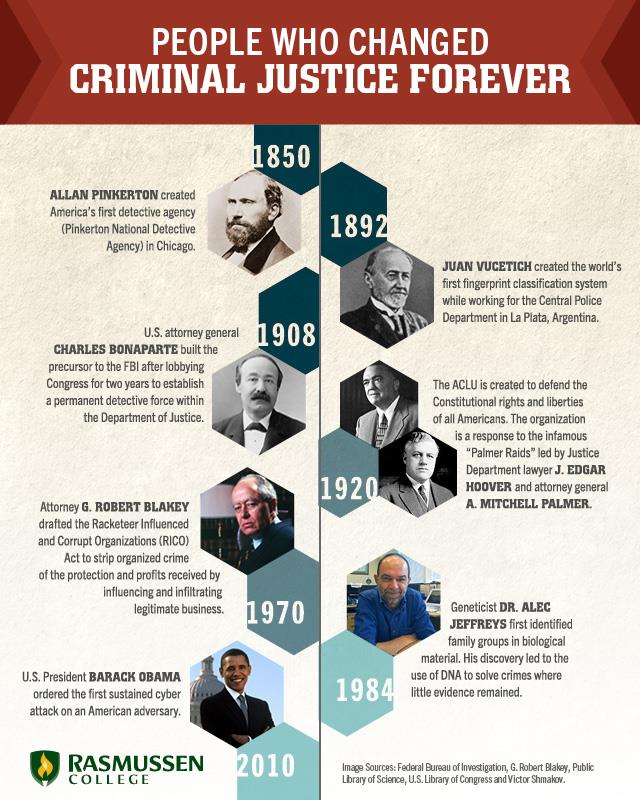
1850: First detective bureau founded
- History: Allan Pinkerton created the Pinkerton National Detective Bureau in Chicago, Ill., in 1850. He received national recognition subsequently uncovering a plot to electrocute Abraham Lincoln in 1861. He too helped organize a federal secret service during the Civil War and somewhen rose to become its primary.
- Today: Pinkerton was caused by Sweden's Securitas AB in 1999. After acquiring 6 other American security firms, Securitas AB became Securitas Security Services U.s.a., the world'south largest individual provider of security services.
1861: First parole arrangement created
- History: First in 1861 and once more in 1877, Zebulon Brockway implemented the concept of "indeterminate sentencing," or parole, while serving as warden of the Detroit Business firm of Corrections and the Elmira Reformatory (N.Y.), respectively. Brockway lobbied the New York Prisons Association to abandon "time sentences" for "reformative" ones that focused on rewardinginmates with shortened sentences for prove of reform, rehabilitation or notable practiced beliefs, according to Samuel Barrows' report The Indeterminate Sentence and the Parole Law .
- Today: By the stop of 2011, almost seven million people were under some course of adult correctional supervision, according to the Agency of Justice Statistics. That number translates to about 2.ix percent – or i in 34 inmates – of the entire prison population of the U.S.
1892: Starting time utilise of fingerprints to solve a murder
- History: While working for the Central Police force Department in La Plata, Argentina, Juan Vucetich created the world'southward first fingerprint classification arrangement – based on early experiments by English scientist Sir Francis Galton. Vucetich referred to his system as "comparative dactyloscopy," and used it in 1892 to identify a bloody fingerprint establish at the scene of a gruesome double-murder of two children. The children'south mother admitted to the killings after presented with the show confronting her.
- Today: In 1892, Vucetich's system identified 101 unlike fingerprint patterns. Today, the FBI's Integrated Automated Fingerprint Identification Organisation (IAFIS) is considered the biggest biometric identification system in the globe – housing the fingerprints of more than 103 1000000 domestic subjects and 73,000 known and suspected terrorists from effectually the world.
1908: First U.S. policewoman hired
- History: With more than than 1.5 million visitors expected to descend upon Portland (Ore.) for the 1905 Lewis and Clark Exposition, officials contracted the Portland YWCA and Lola G. Baldwin to found a traveler'southward aid program. The programme was designed in office to protect unsuspecting women from what officials called the "inevitable con men, pimps and other criminals" attracted to the fair. Baldwin was paid $75 dollars a month during the four-and-half month event and was given arrest authority. She recruited volunteers from Portland's women's clubs to provide surveillance of the 400-acre fairgrounds. She was officially sworn in as the nation'south beginning paid policewoman in 1908.
- Today: At that place are more than 110,000 female constabulary officers across the U.s., according to the U.South. Census Agency.
1908: FBI predecessor created
- History: While serving as U.S. chaser general in 1906, Charles Bonaparte began lobbying Congress for a permanent detective force within the Department of Justice. Bonaparte argued for a squad of paw-picked "special agents" who could investigate perpetrators of timber and land fraud, involuntary servitude and "crimes against the Treasury." An deed of Congress in 1908 created the Bureau of Investigators with 25 special agents and a mandate to find and bring to justice violators of federal laws.
- Today: The Bureau of Investigation became the Bureau of Law Violation Investigators in 1908 and, in 1911, the Federal Bureau of Investigation. As of September 2012, the FBI employed most xiv,000 special agents and more than than 22,000 support professionals.
1920: ACLU formed
- History: The American Civil Liberties Union (ACLU) is a non-profit, non-partisan organization that was created to defend the Constitutional rights and liberties of all Americans. Well-known pacifist and author Roger Nash Baldwin, aslope feminist lawyer Crystal Eastman and law professor Walter Nelles, are credited with founding the organization in 1920. The ACLU was formed in response to the Palmer Raids. The aim of the raids was to simultaneously abort thousands of anti-war protesters – referred to every bit "suspected anarchists and radicals" by J. Edgar Hoover and attorney general A. Mitchell Palmer. Subsequently holding the suspects without charging them and questioning them without representation, the FBI began deporting those with ties overseas.
- Today: The ACLU has get the nation's largest public interest law firm. It has grown to more than 500,000 members with a fifty-country network of staffed, autonomous affiliate offices. Effectually 100 ACLU staff attorneys interact with 2,000 volunteer attorneys to handle close to 6,000 cases annually.
1923: Interpol created
- History: Dr. Johannes Schober – president of the Vienna (Austria) constabulary force at the fourth dimension – created the International Criminal Police Commission (ICPC) between Czechoslovakia, Poland, Austria, Belgium, Red china, Egypt, France, Germany, Hellenic republic, Hungary, Italian republic, holland, Romania, Sweden, Switzerland and Yugoslavia. The system adopted the moniker INTERPOL – a contraction of the words "international police" – in 1946 and its official flag in 1950.
- Today: Based in Lyon (France) Interpol serves equally the intelligence and communications liaison for constabulary forces across its 190 member countries. Operating with an annual upkeep of around €60 million, Interpol provides targeted grooming, investigative support and real-time data to help combat a wide variety of criminal activeness across international borders.
1970: RICO Act drafted
- History: The Racketeer Influenced and Corrupt Organizations (RICO) Human action was enacted as part of the larger Organized Crime Control Act of 1970. It was drafted past G. Robert Blakey to strip organized law-breaking of the protection and profits it received by influencing and infiltrating legitimate business. The RICO Human activity inverse the game for law enforcement because, for the commencement time, the leaders of a crime organization could be punished for orders they gave subordinates. No longer could a mafia dominate insulate himself from legal punishment just because he wasn't physically present when the crimes occurred. Originally written to let prosecutors to go after the American mafia, RICO has been expanded and applied to several high-profile cases unrelated to organized offense.
- Today: Betwixt 1970 and 1985, just 300 civil RICO suits were filed in federal court. That number grew to 614 in 1986 and 957 2 years later. Now, the number of RICO ceremonious cases filed is well over a thousand per year, says Washington D.C. attorney Jol A. Silversmith on his blog 3rd Amendment.
1984: DNA commencement used for biological identification
- History: In September 1984, Academy of Leicester geneticist Dr. Alec Jeffreys plant what he called "a horrible, smudgy, blurry mess" on a slide containing biological material from his assistant, Jenny Foxon. After studying the sample closer, he identified a family group in the sample and realized he could distinguish all three members of Foxon's family by a unproblematic pattern of inheritance. Jeffreys offset used the technique in Apr 1985 to solve a complex clearing consequence that ultimately reunited a young male child from Republic of ghana with his family in England. In 1986, Jeffreys used DNA to abort and convict a doubtable who raped and murdered two schoolgirls 3 years apart.
- Today: Equally of December 2012, the National DNA Index (NDIS) contains more than than 10 meg offender profiles, one.3 million arrestee profiles and 467,000 forensic profiles, according to FBI statistics. The primary metric used to determine the effectiveness of the NDIS is the number of investigations the database has helped. Every bit of December 2012, the Combined Deoxyribonucleic acid Alphabetize System (Codis) has produced more than 198,000 hits and assisted in 190,500 investigations.
2010: Outset government-sanctioned use of sustained cyberwarfare
- History: A highly sophisticated computer worm was plant in June 2010 to be targeting five of Islamic republic of iran's nuclear facilities. The Stuxnet virus was designed destroy centrifuges used to enrich uranium at the Iranian facilities. The New York Times reported in a June 2012 story that President Obama best-selling ordering the Stuxnet assail as a continuation of a George W. Bush-league strategy to demolition Iran'southward nuclear programme. The U.Due south. reportedly collaborated with Israel on the assault. Stuxnet spread through Iran for a full yr earlier being discovered in 2010, co-ordinate to Mikko Hypponen, principal researcher at calculator security provider F-Secure. He too said the worm would likely have taken "ten human-years" to write due to the complication of the code. Stuxnet appears to exist the showtime time a government has sanctioned a sustained cyber attack on the infrastructure of one of its adversaries.
- Today: In May 2012, computer security researchers from Iran, Republic of hungary and Russia jointly discovered "Flame," a new piece of malware targeting Iran's oil fields. 1 of the Hungarian researchers called it "the nearly circuitous piece of malware always constitute." The Washington Post reported in June 2012 that the Flame malware was a product of U.S.-Israeli cooperation and that it contains elements identical to some found in Stuxnet.
From the FBI and fingerprints to DNA and digital warfare, the basic code of police enforcement – i.e., "to protect and serve" – has changed dramatically. All of the milestones mentioned above have ane thing in mutual: they broke new ground in constabulary enforcement. In doing then, they inverse the course of criminal justice forever.
Maybe you're the next criminal justice genius waiting to happen. Download our Criminal Justice Career Outlook to observe your niche!
This piece of ad content was created by Rasmussen University to support its educational programs. Rasmussen University may not set up students for all positions featured within this content. Please visit www.rasmussen.edu/degrees for a list of programs offered. External links provided on rasmussen.edu are for reference only. Rasmussen University does not guarantee, approve, control, or specifically endorse the data or products bachelor on websites linked to, and is non endorsed by website owners, authors and/or organizations referenced. Rasmussen University is accredited by the College Learning Committee, an institutional accreditation agency recognized by the U.South. Department of Pedagogy.
haltonlosoutypery1971.blogspot.com
Source: https://www.rasmussen.edu/degrees/justice-studies/blog/milestones-that-changed-criminal-justice-forever/
0 Response to "what changes have been made in the criminal justice system to address the needs of women?"
Postar um comentário